Monday, September 24, 2012

Week Three: Ovid Today


How relevant are Ovid's themes to our own historical moment? Have we resolved issues he raises? Do we still wrestle with them? How might his "Four Ages" be used to describe our progress or lack thereof? What Metamorphoses do you see occuring around you that may have mythic/epic implications?

I believe that Ovid is merely a conduit for the voices and the events of every age, every time, every place. In this human (and arguably deity) condition we all suffer from, we are bound to love, hate, seek revenge, act foolishly, envy, and try to understand the worlds we inhabit. I am inclined to believe that there truly are only 7 original plots, and the world has become very imaginative in ways to change the people (used very loosely obviously) and the places they occur. 

In the same way Obama being elected president did not end racism in America, so in the same way too I know that the challenges that Ovid and his characters faced are a constant battle that can never be resolved. No technology ever invented will be enough to overcome the power of desire, be that lusting or loving, nor will it cool the flames of vengeance or the flights of folly. These characteristics, these acts are what make us human. To try to escape it is to become that which we are not. Though it may follow the pattern of human curiosity that we try to understand that which we are not (immortality, death, perfection), I believe it highly improbable that humans will ever be more than just that, human. We may choose to strive for a higher standard of living, pursuing arts and holding ourselves to a code of morality, but at our cores, we are nothing more than bipedal, big brained animals grasping for some semblance of belonging in a universe we will never be able to comprehend.

Friday, September 14, 2012

Week 2: Mythic Identity

Are you, or have you ever been, a mythic figure? 

I like to believe that each person is a mythic figure in their own life. I mean, shouldn't we all be the heroes, the archetypes of our own stories? Having role models, basically heroes of the modern age, is an experience many of us know and can understand. I think being a role model to someone, say your younger brother or sister, a friend, elevates you to a mythic status, in that you are an inspiration to be better, achieve more, that sort of thing.

I saw other people posting about their names having mythic origins, so I decided to look up my name. As a kid, I was always frustrated by the fact my name was not common enough to be monogrammed on cups, key chains, little knickknacks. I have a memory of my name being looked up at a younger age, and Tessa meant 4th daughter, which is accurate to my life, as well as harvester/sower of wheat, which is not accurate at all. I was always irritated as a child, and this has even continued into college, when teachers assume my name is Theresa, because Tessa is a diminutive of that name.

When I decided to look up my name again, I found this site - Think Baby Names - and entered my name. I found the information I have received during my childhood was pretty accurate. The 4th child reference came from its Greek origins, while the harvester aspect came from English origins. Of course, to find more information, I was told to look at the "Theresa" entry. So I did. Theresa turned out to be Greek in origin as well meaning "late summer", which I found to be ironic because my own birthday is on the winter solstice. I think classifying that as late summer is stretching it a bit.

Still, there is more to a person than their name. In the book "Eragon" by Christopher Paolini, the witch character Angela asks the protagonist Eragon, "Is that who you are or your name?" to which he replied, "Both." In that case, both name and action became Eragon's legend, his myth if you will.

In that same way, I believe my name befits me and it does not. I am a fourth daughter, but I am not a farmer. I take the light hearted fun of summer though I was born on the darkest day of the year. I don't personally pursue to become a mythic figure, but I hope that my presence on my loved ones makes some sort of impact. I hope that I live on through their memories, and if that requires me to be a mythic figure, than I cannot be unsatisfied with such a classification.

Week 1: Myths In Daily Life

Where do you see myths, mythic figures, or mythic references active in the world around you?

Myths are prevalent in everyday society. To think otherwise is to be blind, deaf, and dumb to any kind of media that we encounter. Actively, we can see myths in advertisements, such as Nike. Nike was the Greek goddess of victory, personifying and emphasizing the company's ploy to instill a sense of triumph and personal achievement in their consumers simply by purchasing and using their products.


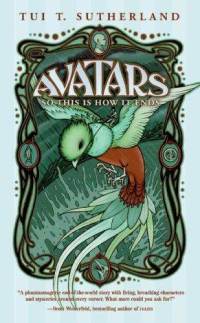
However, I find myth most present in my own life in the books I read. I have always been an avid reader, and mythologies of all origins have been one of my favorite topics. In particular, one of my favorite series, by Tui T. Sutherland, was a three book series called Avatars starting with "So This Is How the World Ends". While it is more of a young adult read, I greatly enjoyed it growing up. The basic premise of the series is that the spirits of all gods from all different pantheons/mythologies (or religions if you choose to think of it that way) are dying out because they survive off of the prayers, offerings, and sacrifices of humans. The already limited supplication to the gods because of the implementations of technology, as well as a higher trend towards atheism and agnosticism leads to a problem of gods slowly fading because they are not worshipped or remembered. This leads the pantheons to convene and decide to create a contest in which a human will be, shall we say, housed with the soul of a god or goddess from each pantheon, and they will fight to the death to see which pantheon will be the center of all worship, leading to the annihilation of all other pantheons. The players (pantheons) of the game are Egyptian, Greco-Roman, Hindu, Polynesian, Mesoamerican, Norse, and Sumerian. Smaller pantheons who did not have as many worshippers joined together in order to compete, as there is no true Mesoamerican pantheon of gods. Without giving too much of the story away, these humans with god souls, also known as avatars, then learn of their heritage and fight. 


While not the most historically or mythically accurate source, I learned a great deal about all of these different mythologies and it lead me to further research. This series, and other books like it, is a key source of mythologies in our modern day and age.